SHOCKER: Democrats accidentally discover how to drown out Fox News
Right-wing billionaires have spent decades building the most engrossing propaganda machine in human history. You know Fox News and talk radio, the multi-billion-dollar foundation. Add Elon Musk’s $44 billion+ X, algorithmically rewired to blast out right-wing content and throttle dissent, AS SCIENCE HAS PROVEN. Add Skydance’s CBS, its news division now preening for the White House. Add TikTok, with whatever the hell goes on there. Throw in a million podcasts, substacks, and YouTube channels running the same plays in irritating, practiced coordination. Top it off with bots of dubious origins to make it all look way more relevant than it should be.
This pathetic yet awesome machine has been eating the left’s footlongs for decades.
Nobody with enough influence or money to stop it or even effectively contest it, as traditional political journalism shriveled into nine top-shelf publications you love to hate. So we were left with the newly renamed MSNOW, the great progressive titles (Mother Jones, New Republic, the American Prospect, Zeteo), Democracy Docket, the podcast factories like Crooked and Meidas, assorted liberal YouTubers, a few dozen incredible newsletters you hope to subscribe to one day, a dormant NextDoor account, and a couple of OnlyFans. It’s not nothing!
But it’s not nearly enough to drown out the right’s Death Star. That fully armed and operational battle station is so loud, large, and shameless that it pulls everything to the right with its tractor beam. It’s so effective that even one of our presidential frontrunners thinks his big move to post up for 2028 is becoming Charlie Kirk Sr.
Some Democratic donors’ answer was to find their own Joe Rogan. Like ABC trying to get into the Diff’rent Strokes action with Webster.
There’s a problem with that instinct: Joe Rogan wasn’t conjured by megadonors. He was a famous dude with thousands of hours of TV and stand-up under his weight belt when he realized he was Rush Limbaugh on different pharmaceuticals. Even that kind of authenticity can’t be bought. It can only be sponsored.
And history, as it does, has surprised us—or reminded us of what’s been right under our nose the whole time. It turns out the left already has our own Rogan. A lot of them. Millions. Louder, more credible, and with their own camera crews in their pockets.
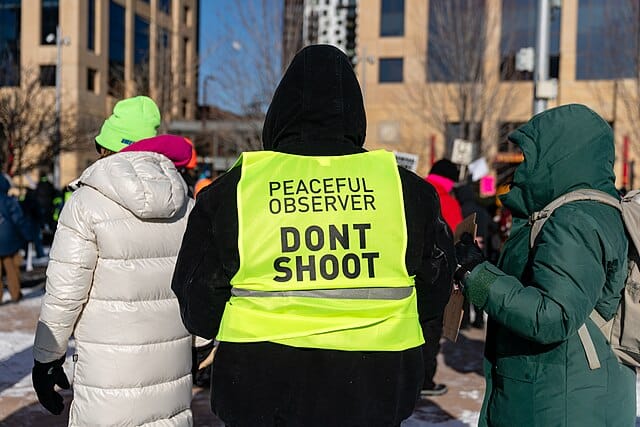
Neighbors in bathrobes with phones. Whistleblowers who decided their conscience outweighed their career. Lawyers who showed up at detention centers uninvited. Epstein survivors who keep walking into rooms the president doesn’t want them in. Teachers who kept their classroom doors open after the vans took the parents. Families of people kidnapped by DHS who refused to disappear without a trace. Clergy who placed themselves between ICE and the people they serve. The neighbor who had never gone to a protest in their life until the morning a van came for the family next door.
What unites all of them is the simplest possible thing: protection of their neighbors. These people have done more to break through the most insidious propaganda machine in human history than anything money has ever funded or organized. And it’s working. If it weren’t for activists, we wouldn’t know much of what’s going on in our country right now. We’d have no idea that the regime was lying about Renee Good and Alex Pretti. Their bodies were still warm when the spin started.
How Trump 1.0 built the resistance muscle that Trump 2.0 reactivated
Trump 1.0 was, among other things, an involuntary eight-year resistance training program for a lot of white people. Indivisible was born from a Google Doc written by two congressional staffers in 2016 and grew into a network that helped flip the House in 2018 and defeat Trump in 2020. When Trump won again in 2024, the resistance didn’t start from scratch. It reactivated. More than 1,200 Indivisible chapters were activated within weeks. The neurocircuitry was already there, waiting for the signal.
That set the stage for TeslaTakedown, one of the most elegant and pointed acts of resistance this country has ever seen.
When Elon Musk was functioning as co-president, and DOGE was moving through federal agencies, activists identified Tesla as the precise pressure point: a company whose customer base was funding the dismantling of the government those customers had voted for. A Boston University professor organized a local protest, posted about it on Bluesky, and within hours, the idea had spread to hundreds of cities. A small crew built a website, a toolkit, and a coordination network. Tesla’s stock dropped over 30%, and profits fell 71% that quarter. Musk pulled back from DOGE by April. And as he did, he opened a wound on Trump’s base by calling out Donald’s starring role in the Epstein Files. That’s a wound that refuses to heal.
Part boycott, part street theater, part economic non-cooperation, the Takedown achieved what The Forge called “strategic spontaneity” at scale.
In praise of whistleblowers — and the neighbors who became them
The word “whistleblower” took on a second, literal meaning in 2025.
When Operation Midway Blitz launched in September, and federal agents began moving through Little Village and Pilsen, community organizer Baltazar Enriquez started wearing a green plastic whistle on an orange lanyard and broadcasting his street patrols on Facebook, picking up on a hack activists in LA had been using since the regime invaded Stephen Miller’s hometown.
One short blast meant ICE was nearby. One long continuous blast meant someone was being detained. Neighbors began distributing thousands of them. Then came Whistlemania, a series of assembly events where hundreds of volunteers put together whistle kits in living rooms and neighborhood restaurants. More than 120,000 kits went out across the city. The tactic traveled to Minneapolis, Denver, Atlanta, and the Chicago suburbs. According to organizers, ICE agents began leaving neighborhoods sooner once they knew they’d been seen. “Form a crowd, stay loud,” read the pamphlets. Chicago popularized the blueprint still in use across the nation.
In Minneapolis, we saw the fullest fruition of these neighborly instincts. One of the most connected communities in the nation stepped up at every turn as the regime escalated and continues to escalate beyond any sense or decency. Activists there say the whistles spread news of ICE’s presence faster than even text messages can.
The other kind of whistleblower has also begun to step up.
Ryan Schwank, a former ICE attorney, came forward to testify that on his first day training new deportation officers in Georgia, he received orders to teach recruits to enter homes without judicial warrants. He watched ICE cut 240 hours of instruction from its training program. He told Congress the whole system is “deficient, defective, and broken.” Schwank spent years writing legal documents and knows which words carry weight. He wasn’t describing a bureaucratic failure. He was describing something intentional: the targeted assault on America’s neighbors.
Without Schwank, there’s only the regime’s version: a crackdown that killed two Americans was a “resounding success.” The only reason there’s a choice between those two stories is that someone risked everything to provide one.
House Democrats confirmed this week that the DOJ illegally withheld more than 50 pages of FBI interviews with a survivor who accused Trump of sexual abuse when she was a minor. That didn’t come from a cooperative Justice Department. It came from survivors who wouldn’t stop showing up. Showing up is the whole theory of change.
This is the pattern. The regime lies. Activists document. The lie collapses.
How activist footage broke through Trump’s media dominance in Minneapolis—and why MSNOW matters
In Minneapolis, Trump’s ICE surge killed two Americans, and the White House tried to sell it as a victory. The regime’s story — agents attacked with a broom and a shovel before opening fire — came apart fast. Not because of institutional journalism. Because activists with phones were everywhere, capturing what happened, sharing it before any version of events could be set.
As Anat Shenker-Osorio put it, Minneapolis shifted the frame entirely. Frame shifts are worth understanding because they rarely happen. Frames aren’t talking points. They’re the prior assumptions that determine who is read as a threat and who is read as a victim. Once those assumptions are set, the argument doesn’t move them.
What moved them in Minneapolis was footage: unnarrated, the record of what occurred, circulating faster than any response could contain it. Every share was a quiet refusal of the official account. Instead of law enforcement containing a criminal population, the country watched people of every background stand together against a federal force that had lost the thread of what it was supposed to be.
And the mainstream media played its own role.
While every other major media company seemed to be tripping over itself to accommodate the regime, MSNOW took the opposite path. The network’s corporate divorce from NBC News landed it outside Comcast’s institutional caution and into something more useful: independence. Rachel Maddow came back to weeknights for Trump’s first hundred days. Rebecca Kutler built a real newsgathering operation from scratch. What followed was the most productive relationship between a resistance movement and a media outlet since Fox News and the Tea Party.
Maddow’s coverage of the No Kings protests was relentless and joyful, arguably the movement's single largest media conduit. When nearly seven million people turned out for the October rally—one of the largest single-day protests in American history—she spent twenty minutes cycling through footage from every state, grinning at crowds in Anchorage and Arkansas and Boston, saying, “Come on. Look at that.”
She tracked the arc: three million at Hands Off, five million at the first No Kings, seven million at the second. She put Chenoweth’s 3.5% rule on screen next to the trend line so viewers could do the math.
At year’s end, she accepted a press award and used her speech to say what she’d figured out: the story of this era is a people story, and journalism’s job is to cover the response, not just the regime.
The movement gave MSNOW the story of the century. MSNOW gave the movement a nightly mirror and a running scoreboard. That feedback loop didn’t create the resistance. Still, it created a self-propagating mechanism that somewhat mirrored the right, yet exceeded it with the key thing the right never had: a relentless sea of activists devoted to the simple protection of their neighbors.
Clergy are putting their bodies between ICE and immigrant communities
Leaders of faith have been working on similar ground.
When the Trump administration barred religious leaders from the Broadview ICE detention facility near Chicago, Catholic clergy sued and won a court order forcing DHS to comply. On Ash Wednesday, priests and a nun walked past barbed wire to give Communion and ashes to detainees while Cardinal Blase Cupich led 3,500 people in a Mass outside. Cupich told the crowd that “the world may look at your legal status, but God looks at your heart.” The Mass included prayers for Alex Pretti, Renee Good, and Silverio Villegas Rodriguez, the three people killed by federal agents in recent months.
The regime wanted that cruelty out of sight. The clergy put it in candlelight instead.
The anti-Trump resistance is bigger, more disciplined, and faster-growing than almost anyone realized
Erica Chenoweth’s team at the Crowd Counting Consortium found that January 2026 saw nearly 5,900 protests, the highest monthly total of Trump’s second term and the third-highest since 2017, behind only BLM and the March for Our Lives.
The resistance has tallied 4x as many protests through January as during the same period under Trump 1.0. In just 41% of tracked events, over 10.3 million people participated in anti-Trump protests. Over 99% of those protests saw no arrests. 99.8% involved no property damage. 99.9% reported no injuries to law enforcement.
This is a patient, coordinated, continent-wide movement. The composure of this movement rarely gets acknowledged. Over 10 million people in the streets, in winter, in communities that have been given every reason to break — and 99% of protests with no arrests. The regime has needed the resistance to look volatile because that’s the only story that makes what the regime is doing look proportionate. The movement has declined to provide it.
As Chenoweth’s work documents, that refusal is not just moral. It is the strategy. State violence looks different when it lands on people who are standing still.
Chenoweth’s research found that nonviolent campaigns are more than twice as effective as violent ones. That participation across races, faiths, and tactics is what separates movements that outlast authoritarian governments from ones that don’t. The coalition showing up in Minnesota, Chicago, and Congressional hearing rooms fits that description. And as Vox’s Zack Beauchamp found, studying democracies that pushed back authoritarian leaders, the scope of civic participation turned out to matter more than most strategists had assumed.
Nobody designed this. Trump 2.0 didn’t just produce the crisis. It produced the evidence of how to move through it.
No replacement for a deep story
One thing would make this durable rather than episodic: year-round organizing in the places where elections turn. What breaks through isn’t a better distribution channel but participatory storytelling, where the audience becomes a co-author. The inclination to build a left-wing podcast giant isn’t misguided, exactly. It just confuses the pipe for the water.
Kate Starbird, who studies disinformation at the University of Washington, points to what actually gives the right-wing media ecosystem its reach: not the hosts, but the way the audience experiences itself as a participant rather than a recipient. Right-wing media gives its audience the feeling of authorship. Every person who shared footage from Minneapolis wasn’t consuming content. They were adding to the record. That dynamic is already present, grown not from strategy but from the weight and clarity of what people are living through. The question isn’t how to produce it. It’s how to build around what’s already there.
It’s such an organic and invigorating experience that it’s made all the screaming fundraising emails and SMSs, which anyone who has ever donated to anything gets, ring false and exploitative. This fundamental shift is also an opportunity to reassess and realign how Democrats funnel their massive pipeline of small-dollar donors who dig deep into their pockets every time Trump pisses them off, which is often.
In 2024, total political ad spending hit $11.1 billion, up from $9 billion in 2020. Democrats outspent Republicans in the presidential race despite losing it: Harris’s operation spent $880 million on ads, Trump’s about $425 million. Democrats outspent Republicans online nearly 3-to-1. 51% of all that spending landed in the final eight weeks—and all of it was aimed at less than 3% of registered voters in seven swing states, reaching people whose minds were mostly already made up.
The neighbors in bathrobes didn’t cost $11 billion. They just had to give a shit. If we could funnel a fraction of those billions to the streets, the difference could change everything.
The Movement Voter Project puts money where the activists already are
The Movement Voter Project is like a mutual fund for the organizers already doing the work. They’ve vetted hundreds of groups in the places where elections are actually decided, pooling donor money behind the ones with track records and real leverage.
Right now, that means knocking 50,000 doors in North Carolina to elect legislators who will hold against GOP bills. That means expanding Wisconsin’s State Supreme Court majority to 5-2. That means funding New Virginia Majority’s redistricting push that could shift four U.S. House seats. They’re training young organizers this spring because nothing useful materializes in October. And at their best, these local organizers are like a “deep story” machine that, by necessity, find the issues that connect to their communities and use them to activate unlikely voters who could radically transform our politics.
For decades, money has flowed into television ads in the final weeks of campaigns, when most minds are set, while the groups doing year-round work that reaches people who don’t usually vote have gotten by on almost nothing. The activists have shown, in real time and with data, that the majority is real, present, and already in motion. The infrastructure to channel that energy somewhere already exists.
That’s why I support the Movement Voter Project. Because we cannot ever hope to build a liberal Death Star — the money and the soul of the thing won’t allow it. But we can find new ways to make use of what turns out to be America’s greatest natural resource: Good neighbors.
Thanks for finding this. If you like what you've found, subscribe toTHE FARCE newsletter, join the LOLGOP Studios Patreon, or drop a tip. Free or paid, your support matters.
Member discussion