That’s not how any of this works, Elissa Slotkin
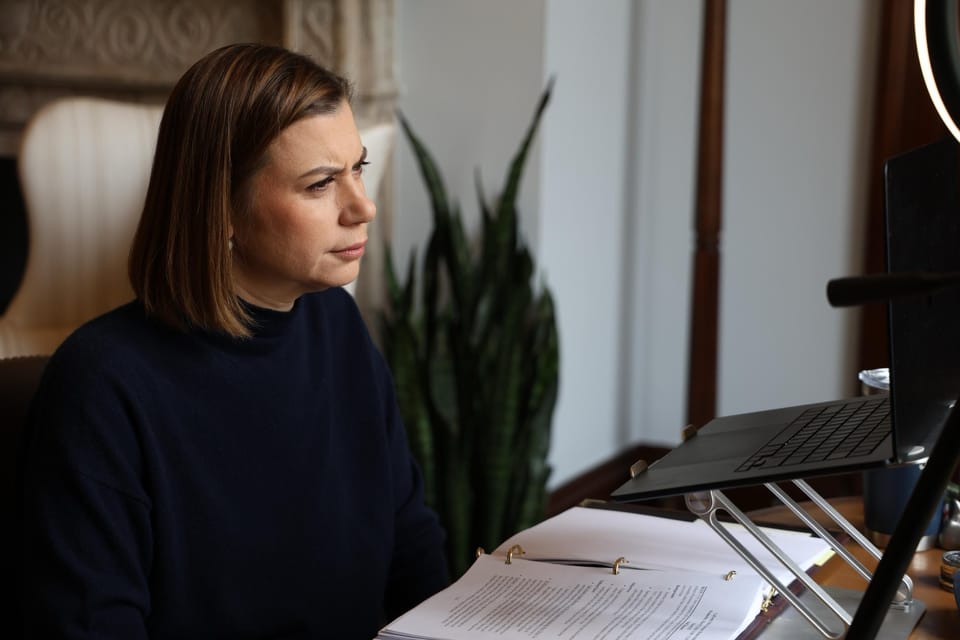
Last week, Elissa Slotkin posted a theory about why Democrats keep losing.
“What works in the middle of the country will work on the coasts,” she wrote, “but not in reverse. That’s why we need to hear from people in places like Michigan, Idaho, and Kansas City.”
She framed it as a wake-up call. It is. Just not the one she intended.
The argument sounds so humble. “Finally, a Democrat willing to call out Democrats!!!” swoons the press, big donors, and Bill Maher.
Of course, it is actually a dog whistle nested inside a strategy argument. “What works in the middle of the country” means: soften the message on immigrants, trans people… You’re making flyover country uncomfortable! In this framing, the coasts are where the ideologues live. The middle is where the real Americans are. Democrats just need to listen to “the real Americans” and stop being so … much.
This evangelicalism of “moderation” is always strange, but it’s sociopathic in early spring of 2026. Does Slotkin think voters really want a “middle ground” on the Iran catastrophe or concentration camps or ICE killing Americans? Would that be Alex Pretti gets killed but not Renée Goode? Or vice versa?
When you frisk it at all, it sounds like blather and wobbles like Jello. But it’s the kind of Jello that has destroyed the Democratic Party brand with hundreds of millions, if not billions, of dollars behind it.
Becoming your opponent isn’t a strategy; it’s surrender
Thankfully, we know there’s a much better way that doesn’t require Democrats to run against Democrats. Anat Shenker-Osorio, whose work on cognitive linguistics and political messaging has shaped campaigns across a slew of countries, puts it plainly: “The idea that the way that you beat your opposition is by becoming them is ludicrous — it does not work both morally, and it also does not work electorally.”
Slotkin’s theory is built on a premise she doesn’t state: that the right-wing propaganda blanketing red-state America reflects what those voters actually believe, and Democrats need to meet them there. It doesn’t, and they don’t. What she’s actually admitting is that she’s as warped by right-wing propaganda as any grandpa who has a divot in his barcalounger that’s been forming since before Bill O’Reilly’s first sexual harassment settlement.
The non-stop hate machine — the talk radio, the Facebook algorithm, the local news gutted and replaced by Sinclair feeds — has manufactured positions that feel like settled conviction but are, in Shenker-Osorio’s data, nothing of the kind. The correct response to a propaganda environment is not capitulation to it. It is a counter-narrative with enough force to overwhelm it.
Democrats already tried this. It was called the 2024 election.
We know this because Democrats tried Slotkin’s approach in 2024. When Trump made the border the issue, Democrats ran on his own border bill — the one Republicans killed specifically so Trump could keep the issue. The lesson Democrats drew was: voters want border enforcement, so let’s offer border enforcement. The lesson the election taught was: given the choice between two Republicans, the public picks the real one. You do not win a bidding war on your opponent’s turf with your opponent’s currency with Donald J. Trump’s signature on it, like it’s a birthday card for Jeffrey Epstein.
Shenker-Osorio’s research divides any electorate into three categories: the base, the opposition, and the persuadables. The persuadables usually run around 60%. And here’s the thing that Slotkin’s theory gets exactly wrong: that 60% generally doesn’t have a fixed position. They are capable of believing multiple contradictory things simultaneously. In the same survey, a majority will support mass deportation, and an even larger majority will support a pathway to citizenship.
There’s no thing that they already believe. That’s Shenker-Osorio’s formulation, and it should end the Slotkin argument before it starts. You cannot craft a message around what the persuadable middle already believes, because they don’t already believe it. They are waiting to be organized, not mirrored with messages they can already get from Hannity any night.
The job of a message, Shenker-Osorio says, is not to say what’s popular. It’s to make popular what needs to be said. And the way it gets popularized is through the base, who act as a choir, spreading the message to their neighbors, wearing it on their shirts, and going out to protest it. A message so cautious your own base won’t repeat it is already dead. It will never reach the persuadable middle because the choir refused to sing.
Arendt knew what happens when you demand everyone be predictable
Which brings us to Hannah Arendt, and why the demand for consistency is not just a strategic error and a moral error — YOU DON’T ABANDON YOUR OWN BASE, ESPECIALLY WHEN THEY’RE BEING TARGETED BY THE WORST VILLAINS ON EARTH — but also a philosophical one.
Arendt spent her life studying how ordinary people become instruments of extraordinary evil, and what she identified at the center of totalitarianism was not cruelty or ideology. It was the elimination of spontaneity — the project of reducing human beings to what she called “never-changing bundles of reaction,” predictable and interchangeable, incapable of surprising themselves or anyone else.
Fascism offers coherence: one enemy, one story, one answer to the contradiction you’ve been made to feel ashamed of. Join us, and you’ll never have to hold two ideas at the same time again. That’s the pitch. And it works because we’ve been trained to experience our own contradictions as embarrassments rather than as evidence of being fully human.
When the left demands ideological “moderation” as the price of admission, it is not holding a standard. It is, in structural miniature, doing the thing Arendt described — sorting people by their predictability, purging the remainder, shrinking the room until everyone left is a never-changing bundle of poll-tested reactions.
Arendt’s counter-argument in The Human Condition is that genuine political action is by definition unpredictable. It cannot be reduced to prior causes. It flows from human freedom, which means it flows from people capable of surprising themselves and everyone else.
The spontaneity that democracy requires — the neighbor in a bathrobe who shows up, the organizer who posts about a whistle and wakes up to find it everywhere — comes from people who haven’t been fully systematized. Contradictions are our only hope. And they’re how we’ll find enough defectors to defeat this regime.
We contain multitudes. The right figured out how to use that.
Republicans are spectacularly inconsistent, and their coalition actively accommodates it. You can want lower taxes and Christian nationalism and Medicare and your immigrant neighbor gone and to be left alone, and the Republican Party will find a use for all of it. Democrats, when they look for consistency, are instead looking to ape Republican critiques of the left that make villains of our base.
Which raises the question of who, exactly, benefits from the Slotkin approach.
A cautious, trimmed-down, ideology-moderated party that makes the right noises and spooks nobody who matters is the wettest dream of the corporate “center.” The donor class would love a Democratic Party that wins and operates like an ineffective Republican Party that doesn’t start unwinnable wars or crash the economy, changing nothing too much materially, especially not for the rich. The Hill reported last year that Democratic donors are frustrated with the party’s lack of message and are threatening to redirect their money toward individual candidates rather than the party. Of course they are. The base is revealing multitudes. That’s exactly the problem.
Here’s what makes this more than a messaging problem.
Shenker-Osorio argues that our political crisis is actually an economic catastrophe in a bad wig. Decades of Democratic governance that delivered for donors and left working people’s material conditions largely intact have built a trust deficit that no amount of carefully tested messaging, bent to the right, can paper mache over. The public is rejecting Trump in large numbers right now. They are not rushing back to Democrats. That gap — between anti-Trump sentiment and pro-Democrat sentiment — is the economic problem.
You don’t close it by moderating to offering half a concentration camp, or by the Strait of Hormuz being closed only on weekends. You close it by delivering something that actually changes people’s lives.
What are we even doing here?
Slotkin probably wants a lefty from Ann Arbor to write exactly this column.
The politics of “judge me by the enemies I have made” — FDR’s line, earned by redistributing power from people who deserved to lose it — are very good politics! But only with the right enemies. FDR made enemies of utility barons and Wall Street consolidators. Slotkin is making enemies of her own base, the most vulnerable parts of her own base, affirming some of the worst caricatures the right-wing hate machine has spent decades spreading.
What she wants you to believe is that courage is actually her functioning as a Republican Super PAC. She says she’s “in the business of winning elections.” Well, she got nearly 24,000 fewer votes in Michigan in 2024 than Kamala Harris, a candidate who lost the state. So maybe she should be taking notes, not giving them.
Shenker-Osorio wants to win, too, but not just for winning’s sake, but to change things, to prevent an even worse Trump.
One of them has the data. The 2026 midterms will be decided by people who voted for Trump and want tariffs repealed. By people who support strong borders and don’t want their neighbor deported. By people who are, in other words, contradictory, conflicted. Which is to say, human, which is to say, persuadable.
And the first thing we need to do is stop surrendering ground to right-wing propaganda, especially when a Democratic junior Senator from Michigan is the one carrying it across the line.
If you made it this far, you’re going to love this episode of Next Comes What by Andrea Pitzer featuring Anat Shenker-Osorio, it’s a master class in persuasion that we all, but especially Elissa Slotkin, need.
Thanks for finding this. If you like what you’ve found, subscribe to THE FARCE newsletter, join the LOLGOP Studios Patreon for as little as $1 a month, or drop a tip. Free or paid, your support matters.
Member discussion