
The worst decline of democracy ever recorded could have been worse. If not for you.
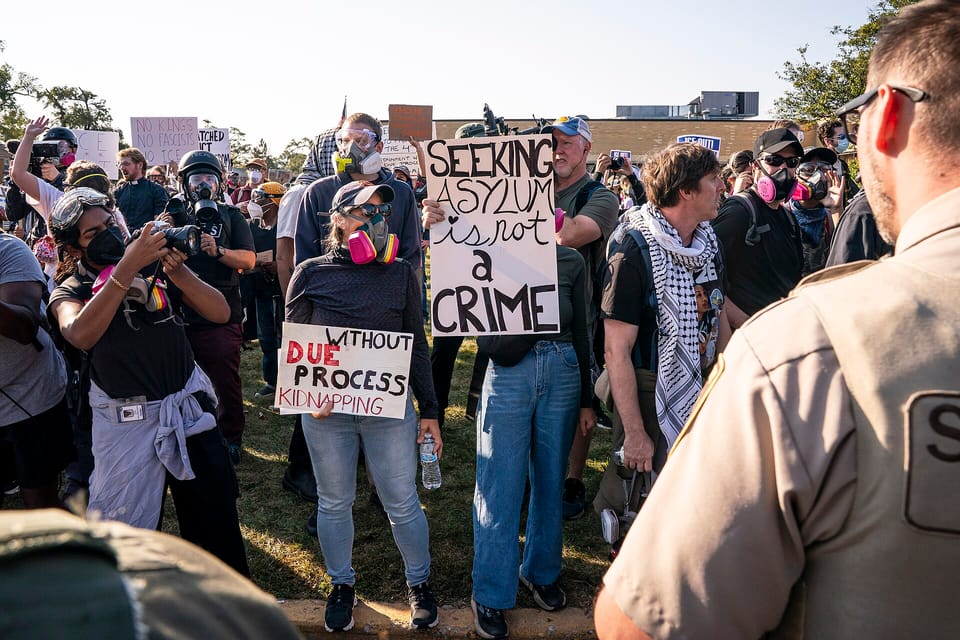
You cannot understand the cycle of escalation that has defined the Trump regime’s attacks on our freedom, and the resistance to those attacks, without saying the name Marimar Martinez.
The teaching assistant was driving donated clothes to a church in Chicago on October 4, 2025, when she spotted a disguised federal vehicle and started honking to warn her neighbors. Border Patrol agent Charles Exum shot her five times. She drove herself to a truck stop, applied pressure to her wounds, and called 911.
What she didn’t know: five days earlier, a CBP intelligence team had already circulated her name, photo, and social media to agents in Chicago — because she had reshared a post from an ICE Watch Facebook group. D.H.S. called her a domestic terrorist. After the shooting, Agent Exum texted colleagues he had “a great new scenario to add to our training.” His boss congratulated him. Someone in the chain texted “FAFO.”
More Chicagoans came out. They swarmed the streets, surrounded the agents who were menacing them, documented the truth, and exposed the regime’s lies. Trump and Stephen Miller backed off from Chicago — my theory is they were also stewing after the historic Democratic gains in the November elections — and waited for a softer target. Three months later, in Minneapolis, Renée Good stopped near a school ICE had been circling all morning and was shot dead. An ICU nurse named Alex Pretti came to her vigil and started going out to document what was happening. Seventeen days later, agents pinned him face down and shot him. Both were called domestic terrorists. What followed was the largest monthly protest total recorded since the BLM uprising — and it is still building.
These are the stories, the people, the V-Dem Institute’s Democracy Report 2026 cannot fully quantify.
The report’s index measures what happened to American democracy. And what it measured last year was the worst single-year decline in American history, going back to 1789. It measures the collapse of legislative constraints as the GOP Congress became Trump’s Duma, the erosion of judicial independence as the lower courts largely stood up. At the same time, the Supreme Court’s opposition arrived late and selectively, the assault on press freedom was mostly welcomed by the billionaire oligarchs who have largely subsumed our media and turned it into an algorithmic mindmeld that presses our buttons more with each click.
What it cannot capture in an index score is everyone who stood in front of all that — all the names of our neighbors who put themselves on the line. By the end of 2025, the Crowd Counting Consortium at Harvard had documented a protest movement running at four times the pace of Trump’s first term — historically large, and historically disciplined: over 99% of events with no arrests, no property damage, no injuries to law enforcement. The No Kings mobilization on June 14 alone reached nearly 38% of all U.S. counties — including counties Trump won by 54 points, such as Harlan, Kentucky, at 88%, and towns where the first protest in either of his terms took place in a national park. By April 2025, the median protest county had voted for Trump. The resistance wasn’t offering cold comfort in safe places. It was everywhere, often in the regime’s faces.
The decline recorded by V-Dem would have been worse — far worse — if not for the people who decided the republic was worth the fight. What happened in January 2026 suggests they were right, and that the fight was only getting started.
But as it continues, let’s use the big findings of the V-Dem Institute’s Democracy Report 2026: Unraveling The Democratic Era?, the most comprehensive peer-reviewed global democracy dataset, to list what we’ve already lost and must dedicate our lives to repairing.
1. The USA is no longer a liberal democracy.
For the first time in over 50 years, the United States has lost the designation as a liberal democracy. The country’s Liberal Democracy Index score dropped from 0.79 in 2023 to 0.57 in 2025. That single-year plunge is the largest in American history — going back to 1789 and covering the entire period for which V-Dem has data. The world rank fell from 20th to 51st out of 179 nations in one year. We went from light of the world to barely in the top quarter of it.
2. Democracy has never declined this fast before.
Viktor Orbán took four years to do to Hungary what has been done here in one. Serbia’s Aleksandar Vučić needed eight. Narendra Modi and Erdoğan each took about a decade. The Trump administration’s pace of democratic dismantlement outstrips that of every prominent autocratizer over the last 25 years. The report’s word for it: “unprecedented in modern history.” Orbán needed four years. Modi needed ten. America skipped the slow burn. Turns out we’re efficient at this, too. The first term was the pilot. The second is the show.
3. Congress mostly bowed to a usurpation of the Constitution.
Legislative Constraints — the index measuring Congress’s actual ability to check executive power — lost one-third of its value in 2025. It is now at its lowest point in over 100 years. The Republican-controlled Congress passed 49 laws last year, almost all on minor issues — one amended the tax code to adjust deadlines for disaster victims. During the same period, the president signed 225 executive orders. So: Congress 49, executive branch 225. The House might want to look at that ratio before it calls itself a coequal branch of anything. The “power of the purse,” enshrined in the Constitution and the 1974 Impoundment Control Act, was taken over unilaterally. The one exception that proved the rule: Senate Democrats held a filibuster for 43 days over ACA subsidies, producing the longest government shutdown in American history. The brakes worked once, briefly, and then gave.
4. The lower courts are holding — but barely, and they’re under siege.
Judicial Constraints also declined, falling to their lowest level since 1900. The administration filed impeachment resolutions and misconduct complaints against district court judges who ruled against it. When the Supreme Court imposed restrictions on tariffs, the president called the ruling “terrible” and the justices “fools” and “lapdogs,” then imposed the same tariff under a different legal provision to circumvent the ruling. (He did not stop calling them lapdogs.) Court Watch is tracking over 600 lawsuits directed at the administration. Federal judges were receiving pizza “doxings” — hoax deliveries sent as threats, using the name of a judge’s son who was killed by a gunman posing as a delivery driver.
5. Freedom of expression is at its lowest level since the end of World War II.
That is the report’s language, not me trolling. The index for Freedom of Expression dropped from 0.94 in 2023 to 0.73 in 2025. The three most rapidly deteriorating indicators are government censorship of media, harassment of journalists, and the presence of critical print and broadcast media. Reporters Without Borders concluded that the “increasingly repressive US president is on track to join ranks of world’s worst press freedom predators.” The president sued the Wall Street Journal for reporting on his ties to Jeffrey Epstein and the New York Times for reporting on his finances and the 2024 election. The White House decided which reporters could cover the president. The Department of Defense required reporters to publish only “authorized” information. That last one is not a metaphor. That is a sentence describing an actual policy that was actually implemented.
6. Civil rights have reverted to pre-Voting Rights Act levels.
The overall LDI score is equivalent to 1965 — the year most analysts consider the start of what we might generously call a complete American democracy. The Civil Rights era’s democratic deficiencies were about legal exclusion from the franchise. Today’s deficiencies are about executive overreach, the dismantling of civil rights enforcement infrastructure, and the suppression of dissent. The Office of Federal Contract Compliance Programs — created in 1965 to strengthen nondiscrimination — was ordered to cease all investigative activity and had its staff slashed by 90%. The DOJ’s Civil Rights Division changed its priorities from protecting marginalized groups to investigating “anti-white discrimination.” Seventy percent of its attorneys left. “Freedom from torture” and “freedom from political killings” registered the most substantial deteriorations in the civil liberties data. At least 32 people died in ICE custody in 2025.
7. Project 2025 is mostly in place.
By early 2026, roughly 52% of Project 2025’s 320 objectives had been achieved, according to the Project 2025 Tracker. The Heritage Foundation published the playbook. The White House ran the plays. The media spent 2023 reporting that Trump had “distanced himself” from it. He had not distanced himself from it. The “Unitary Executive theory” — the fringe constitutional doctrine asserting the president must hold sole authority, which serious legal scholars had long treated as a curiosity — is now the operating system of the federal government.
8. Elections remain the last check standing.
Electoral integrity indicators did not change in 2025. They are only reassessed in election years, and the 2024 elections were free and fair. This is the primary reason the LDI has not collapsed further — and the primary reason the 2026 midterms are the most important elections of our lifetimes, a phrase that has been used so many times it has lost meaning. Still, here we are using it again because it is true again. Already, the DOJ requested election records and voter registration lists from nearly every state and sued the 24 that refused. The FBI executed a search warrant at the elections warehouse of Georgia’s Fulton County — the same county at the center of Trump’s 2020 false fraud claims. Forty percent of the country’s election officials have left since the 2020 election. We know what Trump wants to do with our power at the ballot. The only question is if we will stop him.
9. Reversals have happened. Roughly 70% of all third-wave autocratization episodes were reversed.
Research on democratic U-turns identifies three conditions that make reversal possible: strong institutional safeguards acting as brakes; robust societal action as the engine — unified opposition, active civil society, independent media, sustained nonviolent protest; and acting early, since most U-turns happen around the first electoral cycle. Harvard’s Erica Chenoweth, whose research on civil resistance is a foundation of this field, has found that nonviolent movements of this scale and geographic reach don’t just express opposition — they have historically constrained how quickly autocratization advances, even when they can’t stop it entirely. That is what the people in the streets were doing all year. Seven million people turned out for 2,700 rallies on “No Kings Day” on October 18, 2025. The brakes are damaged but not gone — the judiciary and state governments remain somewhat functioning checks.
10. The world is watching the American experiment conclude or continue.
The level of democracy for the average citizen in Western Europe and North America is at its lowest point in over 50 years — primarily due to developments in the United States. By GDP-weighted averages, global democracy has fallen by over 36% from its peak in 2000. The USA’s decline is behind the sharpest single-year drop in that measure. What is built or dismantled here does not stay here. Democracies fall or endure with an audience and with consequences that spread. The question the report asks — “Unraveling The Democratic Era?” — is addressed to the world. The answer runs through one country, one midterm, one two-year window.
The V-Dem data tells you how bad it got. The Chenoweth data tells you what people did about it. Marimar Martinez tells you what that looks like on the ground: a teaching assistant honking her horn at a disguised federal vehicle on a Saturday morning, because something was happening to her neighbors that shouldn’t be. The republic isn’t saved by waiting for institutions. It gets saved by the people who decide it’s worth the Saturday. The data suggest there are more of them than ever. The only question is whether we can grow those numbers fast enough to make up for all the institutions that have failed us.
Thanks for finding this. If you like what you’ve found, subscribe to THE FARCE newsletter, join the LOLGOP Studios Patreon, or drop a tip. Free or paid, your support matters.
Member discussion