Trump doesn’t lie to be believed. He lies to be repeated.
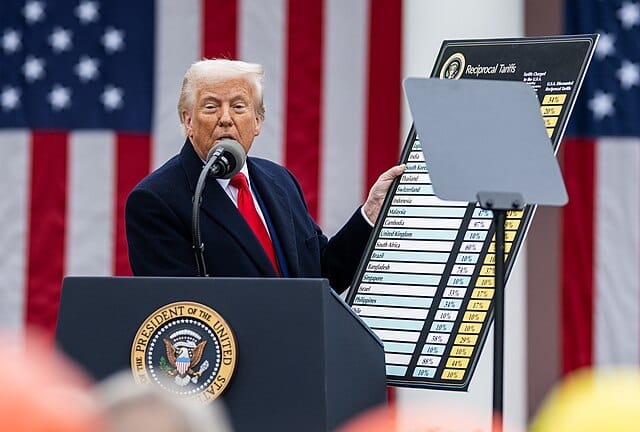
Donald Trump has one thing he needs you to believe about tariffs: other countries pay them. But nope. Survey says: ❌. It’s wrong. He’s wrong. You know it’s wrong. It has always been wrong. Everyone knows that. Every honest economist, every trading partner, and even three Republican Supreme Court justices have all said so. John Deere, for instance, told its investors it was doubling its tariff bill to $1.2 billion in 2026, while laying off workers and warning of price increases for American farmers.
So you probably assume Donald Trump knows Americans bear almost the entire cost of his trade tariffs. But that assumes way too much. First, it assumes he cares. Ha. Also, it fundamentally misapprehends how this freak of history sees the point of speaking words into the world. And it’s time we change, because he never will.
Ten years of debunkings, fact-checks, and explainers. Every one of them has been counterproductive at best and, at worst, helped make him more powerful. There’s a reason for that. And once you get it, life makes far more sense.
Trump doesn’t lie to be believed. He lies to be repeated. Again, Trump doesn’t lie to be believed. He lies to be repeated. See how much more persuasive that becomes just by repetition. I know. It sucks. It really sucks.
Trump becomes Peale, destroyer of sense
To understand this freak of history, you need to refresh your memory or introduce yourself to Norman Vincent Peale. Peale was Trump’s childhood minister and the author of The Power of Positive Thinking, which more or less taught that reality is subordinate to will. Believe something hard enough, and it becomes true. The mind doesn’t interpret reality. It creates it.¹
When Trump says other countries pay his tariffs, he isn’t suppressing a truth he knows. He’s willing his reality into existence.
Repetition is how that works. Every economist debunking the claim, every outraged world leader, every segment on who actually pays: they’re all saying the words. The corrections feed the ritual and center Trump’s narrative. You can’t fight the lie by debunking it. You can only spread it.³
Yielding is the only sin
Layer on top of this what George Lakoff calls “Strict Father” morality, a worldview where strength is virtue, hierarchy is natural, and the leader’s judgment is the moral order. Trump told the New York Times his own mind is the only constraint on his power.² The Supreme Court struck down his tariffs. He replaced them the same day. In his system, that’s the correct behavior. A Trump doesn’t yield. Yielding is the only sin.
Now add in Stephen Miller. Miller doesn’t just enable this psychology; he feeds and weaponizes it. The devil on both of Trump’s shoulders has built an entire ideology around the proposition that every setback is validation, every court defeat proof you need to go harder, every bad poll evidence that the conflict is working. He offers Trump something no other adviser can: a worldview in which Trump is never wrong. Electoral defeats prove demographic threats are real. Public outrage proves the message is penetrating. Historic disapproval confirms the establishment is being shaken. You cannot correct a man whose chief adviser has constructed an unfalsifiable system in which correction itself is the enemy’s weapon.
This is why normal political tools don’t work on Trump. He wasn’t built by normal political forces, and he is surrounded by people whose careers depend on confirming that. He has no fear of the Supreme Court truly checking him or ever needing another job to exert some limits on his fantasizing.
So why wouldn’t he act as if his reality is ours? We are arguing on the terrain he chose, in a language he frames, about a topic he chose. The tools that might check others were designed for politicians who respond to evidence. That isn’t Trump. He was shaped by a theology that treats evidence as an enemy, and staffed by an operative who turns that theology into policy.
The trap he built for himself
So how do we deal with a freak of history whose animating purpose is to destroy the constraints on his mind? Well, it’s much easier when he’s not running for president, as campaigns are the ideal canvas for the power of “positive thinking.” The psychological prison he built to win his fame and campaigns is the same one that makes him fail at governing, every time. As president, his projected fantasies about how he says he would run the country meet the reality of him being a consistently dogshit president.
And here’s the trap the Strict Father built for himself that I wrote about in Gil Durán and George Lakoff’s FrameLab last week: a man who can never admit error can never correct course. That’s a big reason why Trump’s approval has sunk to 37 percent. Majorities say he’s made the economy worse. He promised to lower prices, then said high home prices were good because homeowners should “stay wealthy,” then called the affordability crisis a hoax. He pulled back food tariffs after Republicans lost Virginia by 15 points, but couldn’t call it a mistake, just launched new ones on Truth Social at 3 a.m. He can’t fix it. Fixing it would mean admitting he was wrong.
A deeper story
What can we do? Tell another story. A deeper story that gets beyond quibbling with a liar about what a liar wants to lie about.
During the 2024 campaign, Way to Win presented an alternative vision to Trump’s version of blaming immigrants and DEI for America’s problems. Instead, they put the blame far more rightly on “the richest 1% who have taken $79 trillion in wealth from the bottom 90%.” This rigged-system narrative has everything a deep story needs: It explains a vexing angst, it names an enemy, and presents a way out.
What especially makes it land is how true it is: the billionaires who bankrolled him are getting incredibly richer while he tells you the prices destroying your family are a hoax. Way to Win found that 72% of voters who sat out 2024 chose exactly that story over the scapegoating story when given the choice. It’s already won. It just needs to be told.
Change the questions
That’s why I loved the recent post “Why is Trump so Desperate to Keep Us From Voting?“ from Antonia Scatton, a master Lakoffian and veteran political strategist. She has an idea to reframe Trump’s ongoing interference in the 2026 elections.
When Trump pushes new ID laws and mail-in restrictions framed as fighting fraud, don’t cite the statistics. Ask: Why is Trump so desperate to stop you from voting? That question raises the Epstein files he’s sitting on. It raises the election he already tried to steal and got caught stealing. It even hints at his vast failures as president, such as his tariff betrayals.
Every suppression move now reinforces the story that he can’t win when everyone shows up.⁴ The advantage goes to the side making the assertion. The job isn’t to correct Trump. It’s time to stop helping him and start telling the story he has no answer for.
This freak of history has one weakness: he needs us to keep playing by the old rules. So let’s stop.
Understanding how this freak of history works is only useful if we act on it. I work for democracy independently and full-time. If this piece helped, help back: subscribe to THE FARCE newsletter, join the LOLGOP Studios Patreon, or drop a tip.
¹ It is worth pausing, as we rarely can, to appreciate the goofy audacity of what Norman Vincent Peale was selling. His original proposition was, at its core, a kind of folk Christianity dressed up in the language of self-improvement: that God rewards the confident, the optimistic, the constitutionally incapable of self-doubt. That this philosophy would one day produce a man who, on his first full day in office, stood before the Washington Monument and insisted his inauguration crowd was the largest in history, when aerial photos and Metro ridership data proved otherwise, who looked at a trade deficit that grew and announced it had shrunk, who replaced illegal tariffs with new tariffs the same afternoon a court struck them down: none of this would have surprised Peale’s critics, who called him “God’s salesman” and a con man from the beginning. What might have surprised them is that the con would eventually run the country.
² The full quote, from a January 2026 New York Times interview, is worth letting your brain chew like cud: “My own morality. My own mind. It’s the only thing that can stop me.” He said this as if it were reassuring. As if the sentence “nothing constrains me but my own judgment” were a comfort to offer a democratic republic rather than its precise and clinical negation. There is a word for a system in which one man’s personal sense of right and wrong is the sole limit on his power. We have been dancing around that word for years. We should probably stop dancing.
³ There is a particular cruelty to this dynamic that requires acknowledgment: the people most earnestly committed to truth, the fact-checkers, the economists, the reporters who spend their careers carefully distinguishing what is real from what is asserted, are, by the logic described here, among the most reliable engines of his power. Not because they are wrong to correct him. They are right to correct him. But the correction operates in a media ecosystem that does not distinguish between a claim and its refutation, that measures engagement rather than accuracy, and that rewards the louder signal regardless of its direction. To be the person who says “that is false” in such an environment is to be, in practice, the person who helps repeat the lie.
⁴ The elegance of this reframe, and it is genuinely elegant, in the way that a well-designed trap is elegant, is that it turns his own aggression into evidence against him. Every new voting restriction he proposes answers the question “why is he so desperate?” with another data point. Every executive order, every threatened federal intervention in state elections, every Truth Social meme about rigged ballots becomes, in this frame, not proof of his strength but proof of his fear. And what kind of Strict Father is that scared?
Member discussion