Trump Is Using Your Baby to Keep Elon Musk's Bubble Bloated
What happens when a company’s valuation depends on people believing something its own bondholders don’t? If you’re Elon Musk, you get the federal government to help you convince a newborn’s bank account.
Before we begin: You’ve surely heard about the Trump Account scam. On July 4th, the federal government began wiring $1,000 into a bank account for every American baby born since January 2025.
Who is paying for these accounts Trump named after himself in honor of his discovery that it had been done?
YOU, of course. AKA, the federal government as Republicans gut Medicaid and food stamps. But of course, there is a tax-avoidance scheme for rich dudes stapled to the whole thing. Tax avoidance for rich dudes! Why, is that Elon Musk’s music I hear? Yes! That’s Elon listening to Foreigner, just to feel scared.
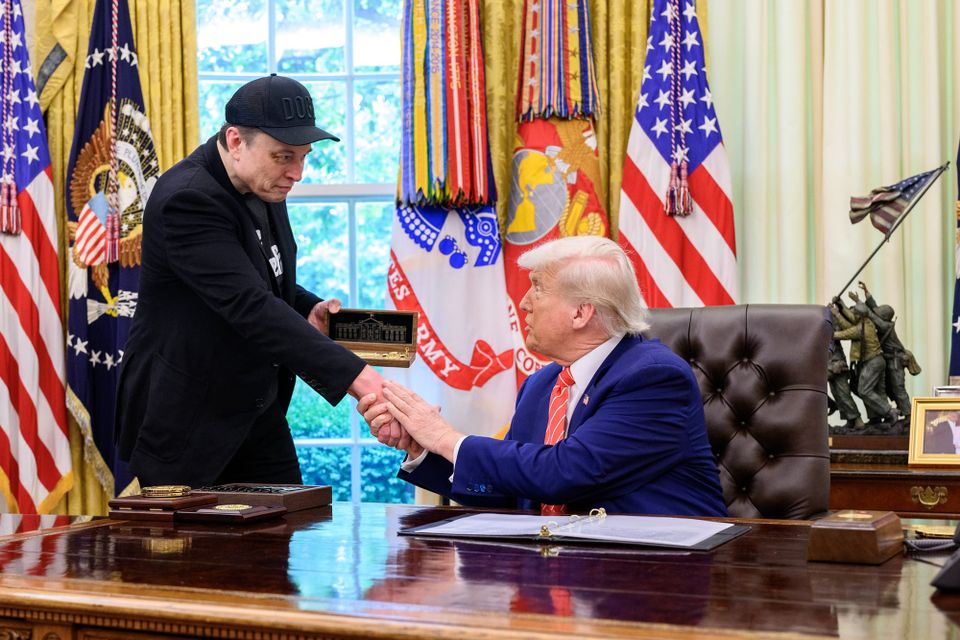
This summer on CNBC, Trump predicted that Elon would help pay for Trump Accounts, in stock rather than cash. He claimed he had not spoken to Musk directly since SpaceX’s IPO made him a trillionaire. He had sent a note instead.
But this plan had been in the works for weeks. Three days before Trump’s interview, Semafor reported that the regime was already negotiating with SpaceX about a stock donation to these accounts, at a time when Treasury’s own rules only accepted cash. Two days after Trump named Musk on television, the Treasury announced that companies could now donate publicly traded stock to the accounts.
Why go to all this trouble for a few billion?
Maybe someone in the regime, or in Musk’s camp, looked at what SpaceX’s own bondholders already believe. The week SpaceX sold $25 billion in new bonds, the value of those bonds fell $305 million, about 1.2 percent. Bondholders are making a narrow bet: that SpaceX can cover its interest payments and return their principal. Stockholders are making a far bigger one. SpaceX calls itself roughly an 80 percent AI company in its own IPO filing, and its current valuation only makes sense if it eventually captures around 20 percent of all after-tax corporate profits in America.
With a valuation that bent from reality, forget the bond market totally. Just have baby bondholders!
A donation to a newborn’s bank account doesn’t need SpaceX to be profitable. It only needs enough people to believe it might be. Who cares that grown-up bondholders, whose entire job is betting on whether a company pays its bills, aren’t really buying it?
Apparently, we’re all now in the business of protecting the trillion-dollar wealth of Donald Trump's biggest donor—the owner of the right wing's ultimate online Death Star. Even as his entire fortune rests on a massive, irrational market bubble, and tragically, even our babies are being used to prop it up.
And even if this weren’t a play to keep Musk afloat, this scheme would still be pilfering the public good. Donating appreciated stock instead of cash lets a donor skip the capital gains tax due on a sale while still deducting the full market value. Economist Gabriel Zucman has documented this maneuver as one reason billionaires pay a lower effective tax rate than the person who empties their office trash can.
A trillionaire who donates stock to a baby’s account collects a deduction on wealth he never has to cash out.
A fifth of SpaceX’s $2.2 trillion valuation is tied specifically to Grok and X, separate from Starlink and launch operations. That slice lost $1.24 billion in 2025 and $609 million more this year, by SpaceX’s own filed numbers. xAI is under active investigation in the EU, India, Malaysia, and by the California Attorney General’s office, after its image generator let users create sexual images of children. Only about 4 percent of SpaceX’s shares are public, according to Dean Baker, a float thin enough that a small circle of Musk’s most devoted stockholders can drive the price largely on their own.
The government’s own promotional website calls the $1,000 a gift courtesy of Donald Trump. The IRS press release describing the same program calls it a taxpayer-funded pilot contribution. Political scientist Rick Baum has pointed out that the money is not guaranteed, not Trump’s, and not available when a family actually needs it. There is no way to withdraw the money, ever, before the child turns 18. Whatever comes out at 18 is taxed and subject to a 10 percent early withdrawal penalty unless it goes toward specific approved uses.
None of the $1,000 can be touched for medical bills, rent, or the year a family’s car transmission dies. It sits in an index fund for eighteen years, collecting a management fee the whole time. The same administration funding this gesture cut Medicaid, food stamps, and housing assistance for people who need money now, not in 2044, as Dean Baker noted in his skewering of the program.
This isn’t only about Musk, of course.
It’s about everyone whose future depends on an AI bubble, likely even you. The regime has bet all of our retirement accounts, mortgages, and jobs on the same con, one that by my lay calculations has inflated past $8,000,000,000,000 as I post this, a number too large for any one billionaire or most nations to hold up alone. Sam Altman pitched a version of the same deal for OpenAI a year earlier, offering the federal government equity instead of paying for oversight of it. Treasury Secretary Scott Bessent wants stakes seeding Trump Accounts. Commerce Secretary Howard Lutnick wants them parked in a sovereign wealth fund.
The industry isn’t just asking for stakes in your kid’s savings account. It wants to write its own rules everywhere else, too. That same month, eleventh-hour calls from Musk, Zuckerberg, and David Sacks talked Trump out of signing an executive order on AI regulation he had been expected to sign that week. The same men asking Washington to help sell the bubble are also deciding whether anyone gets to inspect it.
If this feels like a pattern, it is. But it’s worse than that. It’s a kill chain.
This is what we’re tracking at Stop the Trillionaires. The live math behind this piece updates in real time: stopthetrillionaires.com/ai-bubble. And support this project at my Patreon.
Member discussion