How to Save the Democratic Party Brand in Two Impossible Steps

The Democratic Party’s brand is hemorrhaging.
If you’re among the small percentage of Americans who don’t already know that, you might be a Democratic senator who keeps voting to confirm Trump’s nominees even after he’s waged illegal wars abroad and against people of the United States. And/or you might think the fix is sounding more like Trump on immigrants or trans kids — which is roughly what happened in 2024, when Democrats begged to pass Trump’s border bill and let a wave of attacks on trans rights go virtually unanswered.
You can’t fix a problem like that with a new font, a new slogan, or a retread of the exact playbook currently running the UK’s Labour Party into a bitter, technocratic abyss. And ultimately, it will be up to the 2028 nominee, if our timeline stays somewhat consistent with recent history, to remake the party in her image. But we don’t have time to wait. History is happening too fast.
Trump is obviously trying to steal the 2026 elections, and the way we know a Trump presidency goes, after a few years of this chronic incompetence, malfeasance, and exploitation of the country, a crisis will ensue that will disrupt all of our lives and likely have us hunting our neighbors for toilet paper.
For once, Democrats need to get ahead of the puck and take a stand that will define it for the rest of the century. If Democrats want a brand that resembles the party of the New Deal and Civil Rights era — workers over wealth, people over the pillagers, fairness over the favored few — here’s an obvious way to start:
- Call out the AI bubble before it bursts.
- Make the people who inflated it — and became unconscionably richer off it — pay.
This is a two-step that even the white folks at the Bar Mitzvah can master.
So why does that feel impossible?
The Anatomy of a Weakness
Let’s start with the data if you pretend to think polls are all that matter.
In April, ABC News, The Washington Post, and Ipsos asked Americans an open-ended question: what’s the worst thing about each party? Of all the possible answers, for either party, only one broke double digits. Not corruption. Not extremism. Not any specific policy. Ten percent of Americans said the worst thing about the Democratic Party is that it’s weak and won’t stand up to Trump or for what’s right. Among Democrats asked about their own party, that number was 24 percent. Democrats are more likely to say their own party won’t fight than Republicans are to say anything at all about theirs.
By July, that sense that Democrats don’t have your back has manifested as a concrete electoral crisis. As G. Elliott Morris notes, “double haters”—voters who hold unfavorable views of both major parties—have surged to historic highs. These aren’t just disengaged citizens; they are voters actively looking for an alternative to a Republican party they find dangerous and a Democratic party they find utterly vacant. They are waiting for someone to give them a reason to choose. Or, better yet, care.
And you know why they aren’t yet finding it from Democrats. And you know it didn’t start with Trump.
Obama said explicitly, in his first weeks in office, that the country needed to look forward, not backward — talking about a torture program that had sent detainees to black sites and left the United States defending waterboarding on the Sunday shows. Nobody who built that program went to prison. The instinct repeated itself on the 2008 crash: Congress and the Fed bailed out the banks that wrecked the economy, and the people who ran them kept their bonuses while nearly 10 million families lost their homes. Eric Holder, running the Justice Department that was supposed to hold them accountable, told Congress in 2013 that some banks had gotten too big to prosecute without risking the broader economy — the country’s top law enforcement officer admitting, on the record, that some fortunes sit beyond the law’s reach.
Look forward, not backward, was supposed to be magnanimous.
What it actually taught two generations of institutional Democrats was that the party’s instinct in a crisis is to let the guilty walk so everyone can move on. That posture is how you end up letting Donald Trump win not once but twice — the second time after the worst Covid response of any wealthy country, after January 6th, after Roe fell. Each time, the party’s answer was some version of the same idea: don’t relitigate, look forward, focus on the next election. The next election kept arriving with the same unpunished people punishing us for our lack of fight.
So how do you show fight?
You don’t do it by promising, again, to fight harder next time. You do it by walking up to the biggest injustice you can find — the biggest catastrophe still unfolding, in plain view — and naming it before it’s safely in the past tense, even though naming it might cost the people responsible something, even though those same people are spending billions this election either to help you or bury you if you don’t shut up.
We all know what’s happening.
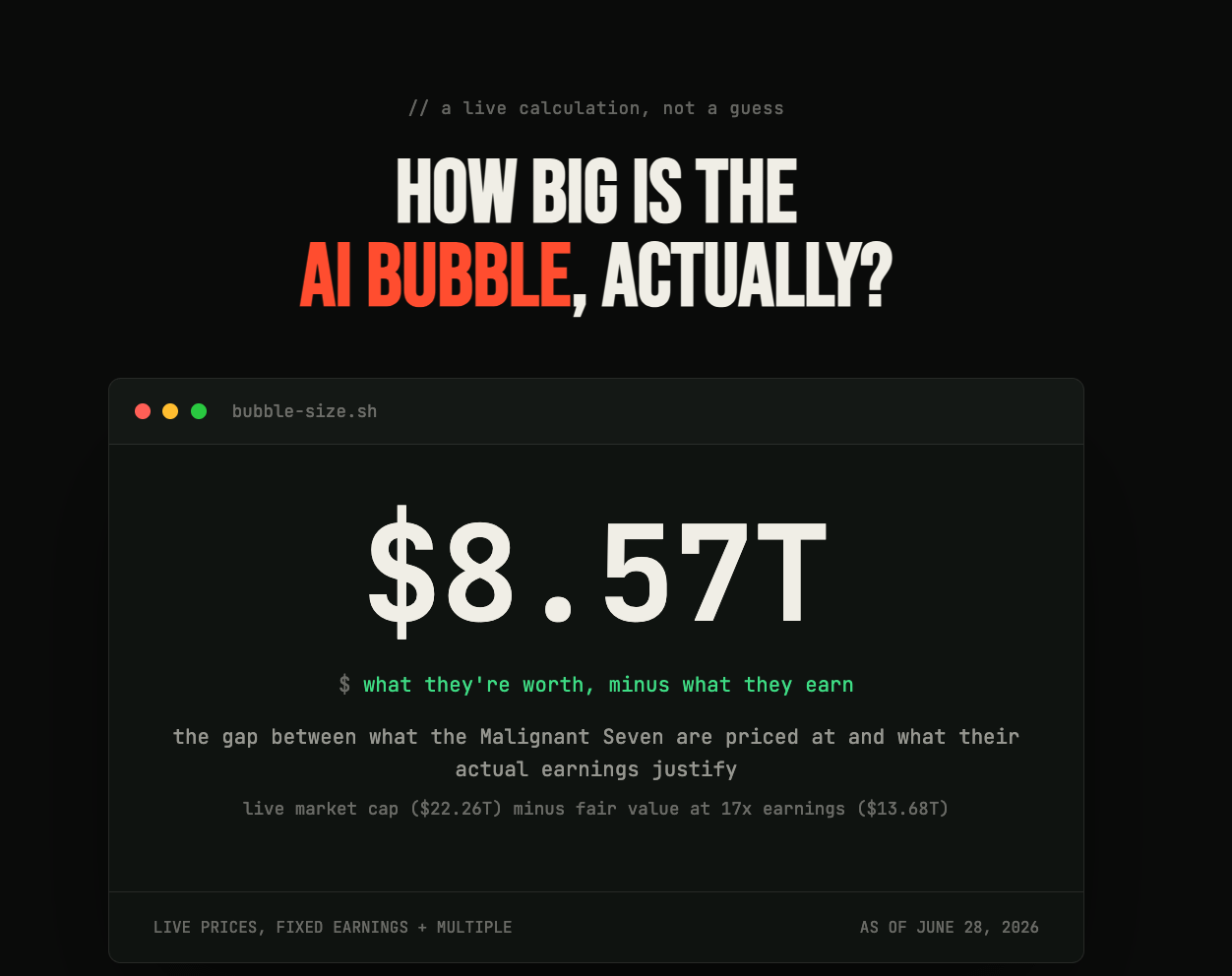
We’re living through an AI bubble that threatens to put millions of people out of work. It has quietly loaded itself into the retirement accounts of tens of millions of Americans who never chose to bet their 401(k) on it. And even if it “succeeds” and never wrecks the broader economy, it’s draining the water and power we need at the exact moment we still have a chance to hold off the worst of the climate crisis — accelerated by a regime that has deliberately committed itself to making energy dirtier and more expensive. It’s so massive and hard to picture that we built a live tracker to show the number and the context behind it
Here’s the part that should make this an easy call.
The public is already ahead of the Democratic Party on an issue it should own. YouGov found that 71 percent of Americans think AI development is moving too fast, and twice as many are pessimistic about its long-term effects as optimistic. Just 27 percent of Americans believe a data center would meaningfully create jobs or growth in their own community — which is close to why 71 percent of Americans oppose having one built in their backyard.
STEP ONE: Call the bubble before it bursts.
Greg Casar, who chairs the Congressional Progressive Caucus, told Politico this month that his own party is letting AI money scare it into silence — the same instinct that looked forward instead of backward on torture and the banks, showing up again, on schedule. “We absolutely cannot let the AI money silence us,” he said. He’s specific about what fighting looks like: tax the tokens that power AI compute, put safety guardrails on chatbots, ban companies from using your own data to set the price you pay, require data centers to generate their own power rather than draw from the public grid. House leadership is running on something much smaller — protecting electricity ratepayers, keeping Trump from writing the AI rulebook alone — the institutional version of look forward, not backward, applied to a crisis still in progress.
Nearly 200 economists just made calling it out considerably easier to defend. A statement titled “We Must Act Now,” signed by 15 Nobel laureates and the chief economists of OpenAI and Anthropic, warns AI’s disruption could hit faster than the Industrial Revolution and unfold in a fraction of the time. Some of the signers spent years telling their colleagues the AI panic was overblown. They signed anyway. And the market’s own numbers are already admitting what the politics haven’t caught up to: economist Dean Baker found that American AI usage actually fell last week, for the first time in this boom, while Chinese usage pulled about 40 percent ahead. Baker’s prescription for the money managers still pricing this like a sure thing, the same instinct that once turned subprime mortgages into AAA bonds:
This time, he says, “Let them eat their losses.”
STEP TWO: Make the people who inflated it pay.
This is the part Democrats have never been good at, because it requires deciding someone specific is guilty and saying so before the crisis is safely over. It requires something like the Pecora Commission that investigated the causes of the Great Depression — and it requires doing it now, before the bubble bursts, not after. The aim has to be actual accountability: if not criminal charges, then taxes and consumer protections that gut this generation of robber barons’ power and wealth while there’s still something left to gut.
Start with what’s already been taken. Virginia handed out $1.6 billion in data center tax exemptions in a single fiscal year. Michigan? $13 million. Texas revised its own projected cost from $130 million to over a billion dollars in two years — a miscalculation the size of a small state’s transportation budget, and nobody responsible for it lost their job. Goldman Sachs itself has admitted that all of this spending added basically zero to actual American economic growth last year, because the hardware is built overseas and the growth shows up on someone else’s ledger.
The industry isn’t hiding who it’s building this for. Palantir’s Alex Karp told CNBC, without apparent embarrassment, that his technology “disrupts humanities-trained, largely Democratic voters, and makes their economic power less” — not a warning to anyone, a pitch to the people who’d like that outcome. Sam Altman told BlackRock investors he sees intelligence becoming a utility, something you’ll pay for on a meter, the way you pay for water or electricity now — except the people setting that meter are the same ones this bubble is about to make richer than anyone in human history has ever been.
The local cost is already documented, county by county. In Morgan County, Georgia — rural, overwhelmingly Trump country, an hour east of Atlanta — well water turned visibly muddy after a Meta data center broke ground, muddy enough that Rep. Alexandria Ocasio-Cortez carried a jar of it into a congressional hearing. In Coweta County, another rural county outside Atlanta, Georgia Power is seizing easements across more than 330 properties by eminent domain for an 829-acre campus nobody living near it asked for. In Memphis, xAI is running unpermitted gas turbines next to a neighborhood already failing federal smog standards, and the NAACP has sued.
None of it is unbeatable. When residents of Lisle, Illinois pushed back on a data center proposed for land that had already poisoned their drinking water once, the developer simply withdrew. No fight. No settlement. Just gone. That’s what it looks like when the other side finds out the fight is going to cost them something.
Sen. Elizabeth Warren is pushing for transparency on what these facilities are doing to your power bill. Sen. Bernie Sanders and Rep. Alexandria Ocasio-Cortez want to pause construction until real rules exist.
Meanwhile, “moderate” Rep. Sam Liccardo runs a group called “Innovation for Good,” which shuttles nervous House Democrats to Silicon Valley fundraisers and coaches them to worry out loud about data centers without ever using the word moratorium. This is the AI industry using campaign checks to make sure there are never any real checks on it.
Why this actually matters
Even the industry’s own side is admitting the messaging has flopped. Microsoft CEO Satya Nadella recently complained that AI companies openly talking about replacing entire categories of workers is bad for business — his objection isn’t that it’s happening; it’s that people keep saying so out loud.
As Anat Shenker-Osorio put it in “Bringing a Survey to a Gun Fight,” her definitive case for the party standing on values instead of chasing polling: MAGA is doing exactly what it promised, and voters can see it “hand the wealth our work creates to their billionaire backers.”
AI has picked its side. They literally picked the vice president.
Democrats could try to be the second-best AI kiss-asses in every race, or they could fix their brand.
They could call the bubble before it bursts. They could make the people who inflated it pay for what it’s already cost and the misery that’s coming.
Be right back — going to go get rich making a bet on Polymarket on which way this goes.
Zero trillionaire funding. 100% reader-backed.
To keep our analysis uncompromised and fierce, subscribe to THE FARCE newsletter, join the LOLGOP Studios Patreon, or drop a tip. Free or paid, your support keeps us independent and fearless.
Member discussion